


Global shipping industry sticks with green investments, despite carbon price delay
- Shipping accounts for nearly 3% of greenhouse gas emissions
- IMO to consider carbon price again this year
- Shipping, energy companies forge ahead with green investments
- Rules may change again over ships' 30-yr lifespans, Wartsila CEO says
The shipping industry's biggest players are shrugging off Trump administration opposition to a global carbon price and are forging ahead with billions of dollars in emissions-reducing investments, according to company officials and an analysis of data.
Europe, Brazil and a host of other nations are pushing the sector, which is responsible for nearly 3% of the world's greenhouse gas (GHG) emissions, to go green. But, in October, the U.S. and Saudi Arabia, the world's two largest oil producers, successfully spearheaded efforts to postpone by one year a decision on the International Maritime Organization's (IMO’s) proposal of a $380-per-metric-ton levy.
Some analysts and industry observers initially warned that the absence of such a global framework added complexity to companies' planning and could cause some to pause their green investments.
But in interviews with 15 shipping companies, ports, bunker suppliers and marine technology companies, 10 said that regional regulations, long investment lead times, and expectations of a continuing trend towards decarbonization all argued in favour of staying the course.
And an analysis of vessel delivery data through 2028 showed orders of ships capable of running on alternative fuels dominating new shipbuilding.
Hakan Agnevall - chief executive of Wartsila, a major producer of ship engines and exhaust gas cleaning scrubbers - said that a one-year carbon price postponement is unlikely to rattle customers like his, who generally take a 30-yr investment perspective.
"It's not bold to say that regulations will change during those 30 years."
Dual-fuel vessels dominate new ship orders. Most of the nearly 50,000 commercial ships operating globally today run on fuel oil or gas oil. But in a unanimous decision in 2023, IMO member states set a target of net-zero emissions by or around 2050.
Firms have, in anticipation, begun ordering dual-fuel ships that can use both fuel oil as well as greener alternatives like liquefied natural gas, methanol and ammonia.
While Pacific Basin - a large dry bulk ship owner - did opt to buy four newbuild vessels running only on oil-derived fuels, citing the postponement of the IMO's carbon price, the company is an outlier.
Unlike other sectors - from energy to auto manufacturing - that have curbed their green ambitions in a rollback that has only accelerated since Donald Trump's return to the White House, the shipping industry has, so far, declined to pivot.
Major ship owners have reiterated their commitments to invest in emissions reduction measures, including dual-fuel vessels and onboard energy-saving devices.
By the end of December, companies had invested > $150 B in dual-fuel vessels, according to an analysis of data from the World Shipping Council, an industry group for container shipping and vehicle carriers.
In total, 1,126 dual-fuel container ships and vehicle carriers have now been either delivered or are on order, the data showed. That marks an increase of 28% compared with the previous year, indicating that newbuilding orders for lower-emissions fuel vessels continued even after the IMO delay.
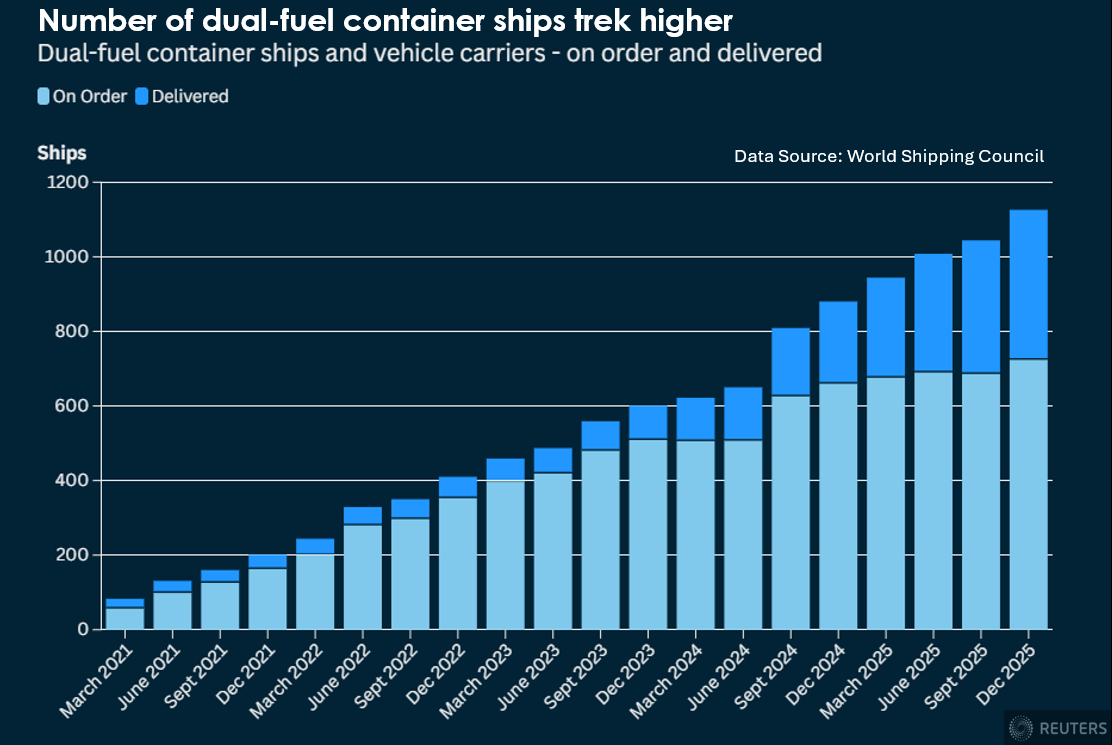
(Click image to enlarge)
They also continued to outpace orders for traditional ships, with dual-fuel vessels now accounting for 74% of the overall container ship and vehicle carrier orderbook. And investments in new marine fuels are also moving ahead.
Alexander Saverys, CEO of Belgian ship owner CMB.Tech, said it will continue investments in both ammonia bunkering and production.
A Mitsui O.S.K. Lines spokesperson told media the IMO postponement just means a longer transition to low and zero-carbon fuels, and the company is still focused on LNG-fueled vessels and early-stage adoption of ammonia and methanol.
Maersk, among the first to explore emissions-reducing alternative fuels, initially opted for methanol but has since ordered LNG-fueled ships and has now also started testing ethanol as an alternative.
NYK Group, which reaffirmed its emissions reduction strategy after the IMO decision, sees the one-year delay as an opportunity for discussion and refinement of the regulatory framework, a company spokesperson said.
"While recent regulatory uncertainties might lead some operators to take a more cautious approach, the overall direction of maritime decarbonization has not changed significantly," said Jason Stefanatos, decarbonization director at maritime consultancy DNV. "The commercial drivers still remain."
Despite IMO delay, green incentives are expanding globally. Many companies cited regional green fuel regulations among the main reasons for moving ahead with investments.
The European Union's FuelEU Maritime, which requires vessels to pay penalties for failing to achieve lower emissions, makes a business case for greener fleets, ship owners and fuel suppliers said. And the EU Emissions Trading System and voluntary initiatives provide further incentives.
Ship owners with dual-fuel vessels will likely use them on EU voyages to avoid paying FuelEU Maritime penalties, and some should also receive rewards for over-compliance, said Kenneth Tveter, an analyst at shipbroker Clarksons.
"The case for low-carbon fuels such as ammonia and methanol is still alive if you have a trade concentrated around Europe," he said.
Major Horn of Africa port Djibouti and OPEC member Gabon have also introduced levies on maritime emissions, and current momentum could see punitive regulations and incentive schemes introduced in other important shipping hubs soon.
Britain, notably, has proposed to expand its emissions trading system to international shipping from 2028. And Turkey is considering a scheme similar to the EU's.
Such factors should drive demand for LNG, bio-LNG and biofuels over the next five years, said Nacho de Miguel, head of alternative fuels at bunker supplier Peninsula.
"Whilst the IMO's net-zero framework has been postponed, this does not change our strategy," he said.



Comments