


What is China's next surprise for oil markets? Lower imports, higher fuel exports?
If there is a surprise to China's response to the Iran conflict, it's not that the world's biggest crude importer cut back on oil imports and refinery processing, it's the extent to which it did.
China has a strong track record of lowering crude imports in response to higher prices and boosting arrivals when they decline.
But the collapse in imports to the lowest in nearly 10 years in June was dramatic, especially given that even though crude prices did surge in the weeks after the U.S. and Israel attacked Iran on February 28, they didn't scale the heights reached in 2022 when Russia invaded Ukraine.
China's June crude imports were 7.12 MMbpd, the lowest since October 2016 and down 41.3% from the same month last year, according to official data.
Ordinarily a drop of that magnitude should have resulted in a massive draw on China's inventories, but this didn't happen.
Rather, China's refiners cut processing rates to 12.47 MMbpd in June, down 17.7% from the same month in 2025, the lowest point since March 2020, which was during the COVID-19 pandemic.
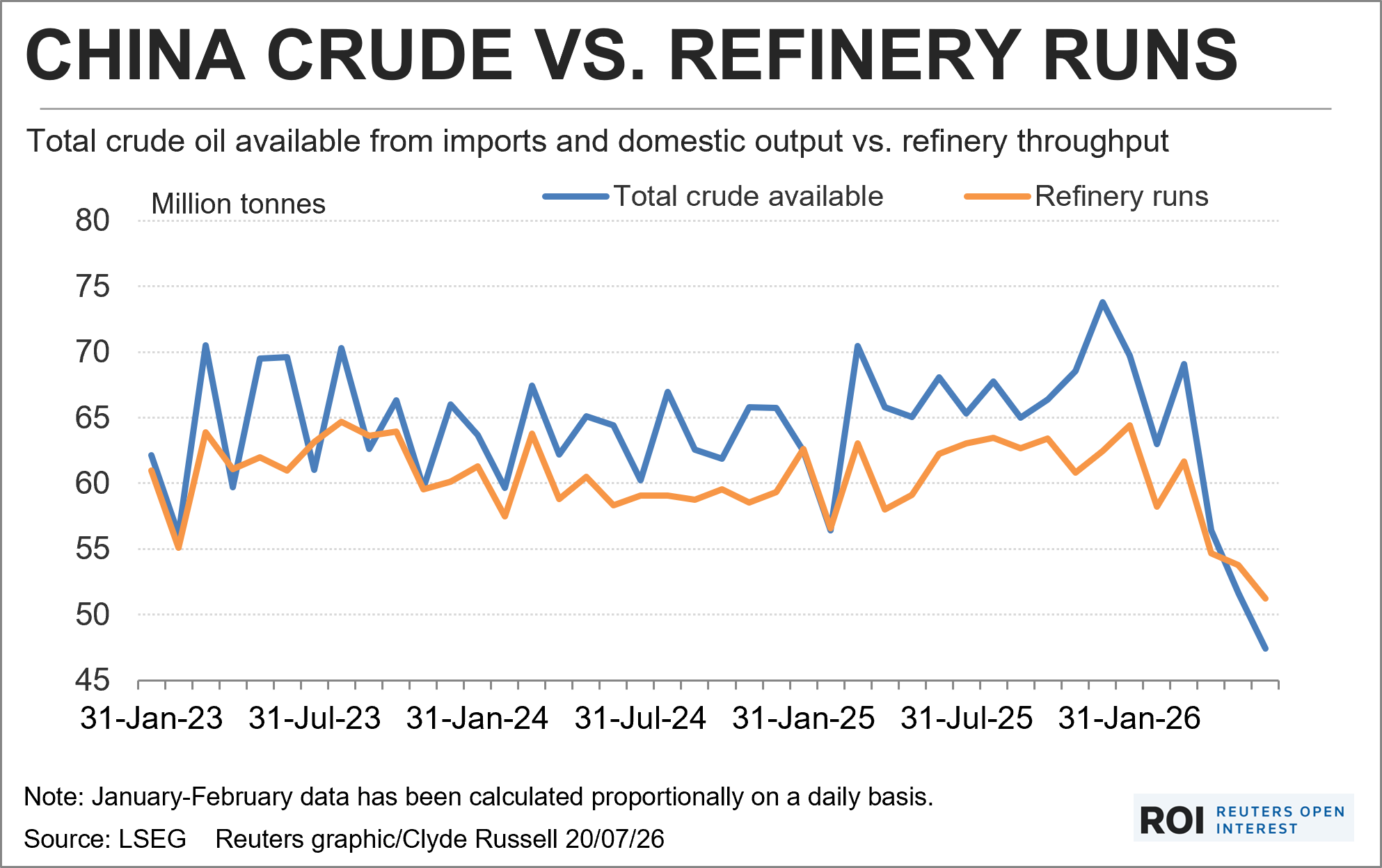
(click image to enlarge)
China does not disclose the volumes of crude flowing into or out of its strategic and commercial stockpiles, but an estimate can be made by deducting the amount of oil processed from the total crude available from imports and domestic output.
On this basis, crude oil imports of 7.12 MMbpd and domestic output of 4.41 MMbpd means refiners had a total of 11.53 MMbpd available.
They processed 12.27 MMbpd, meaning that about 940,000 bpd was drawn from inventories, up from about 500,000 bpd in May.
Despite drawing on stockpiles in the past two months, China still added to reserves for the first half as a whole, with surplus crude of around 530,000 bpd.
Part of the reason China was able to cut refinery runs sharply in June was because Beijing placed unofficial restrictions on exports of refined products, a response viewed as a measure to ensure sufficient supply of fuels to the domestic market during the Iran conflict.
China exported 393,000 bpd of light and middle distillates in June, according to data compiled by commodity analysts Kpler, slightly down from about 400,000 bpd in May but up from the 54-month low of 338,000 bpd in April.
There is little doubt that China has played a significant role in adjusting demand for crude oil during the current Iran crisis, which has seen the loss of around 10 MMbpd of crude and refined product supply through the effective closure of the Strait of Hormuz.
But China has also contributed to the tightness in product markets by cutting back on its exports since April.
The question for the market is what is China likely to do in response to the ongoing crisis.
Prices key. If the answer is viewed through the prism of prices, China may be lining up another surprise for the market.
It's likely that China's crude oil imports will recover in August and September as refiners are likely to have bought up cargoes that managed to exit the Strait of Hormuz during the brief ceasefire between the U.S. and Iran.
That period of about three weeks from mid-June saw crude oil prices plunge as the market anticipated a return to normal supply from the Middle East and therefore a likely glut.
Benchmark Brent oil futures dropped as low as $70.14 per barrel on July 2, having been as high as $126.41 at the end of April. However, the return to hostilities has seen Brent climb back to $90.80 a barrel in early Asian trade on Monday.
The rebound in crude prices will probably see China's refiners ease back on imports, meaning lower arrivals from October onwards given the lag between when cargoes are arranged and delivered.
The wild card is what happens to China's refined product exports.
Beijing may have the confidence now that it can exist on its vast stockpiles of crude, with estimates of holdings of at least 1.2 Bbbl.
China may also be tempted to increase refinery processing rates and lift product exports to allow refiners to capture the high margins on offer in Asia.
Gasoil, the building block for diesel, ended at $143.03 a barrel on July 17, a premium of $54.93 to the closing Brent prices, and nearly three times the $18.94 premium that prevailed on February 27, the day before the U.S. and Israel attacked Iran.
There are some early signs that Beijing has relaxed its unofficial restrictions on product exports, with Kpler tracking shipments of 787,000 bpd of light and middle distillates for July.



Comments